

By Mo Edjlali, Founder of Mindful Leader; Author, Open MBSR
Epstein, Deepak, and Authority Illusions
You've seen it happen. A revered teacher's private correspondence surfaces. Social media erupts. The disturbance isn't mere disagreement. It's disorientation. This doesn't match the person I thought I knew.
I’ve been feeling a great deal of that lately. We all have.
It's hard to deny that Jeffrey Epstein is on everyone’s minds. I searched the files on Jmail, checked for people I knew, searched for meditation, and had to see for myself the Deepak Chopra correspondence.
We've spent years training our minds to see clearly, to notice the stories we construct, to recognize the gap between perception and reality. Yet we remain remarkably stupid to the oldest cognitive shortcut in the book: mistaking prestige for decency.
I include myself in this. More than I'd like to admit.
The Architecture of Authority
Information is always incomplete. The mind has to simplify. It constructs simple models of other people because it must. How else can we function?
But the mechanism has a shadow side, and prestige is the shortcut that exploits it.
Visibility, fluency, institutional presence, and social proof. These signals stabilize perception by reducing uncertainty. A polished public identity becomes mentally efficient. Status stands in for scrutiny.
The mechanisms are well-documented: halo effects, authority bias, prestige heuristics. Once a figure is encoded as credible or wise, perception reorganizes around that assumption. Consistency is expected. Dissonance is resisted.
Until it isn't.
When something suddenly disrupts our constructed image of people, especially those that we cherish and admire, it can feel destabilizing, even unreal. Our mental shortcut is short-circuiting. The model fails. Our reality crumbs. Best-case scenario, we remember that the map was never the territory. Worst case, we cling stubbornly to a false reality.
The Shadow We Know Too Well
This is not new to the mindfulness field. This dynamic is unfortunately quite familiar.
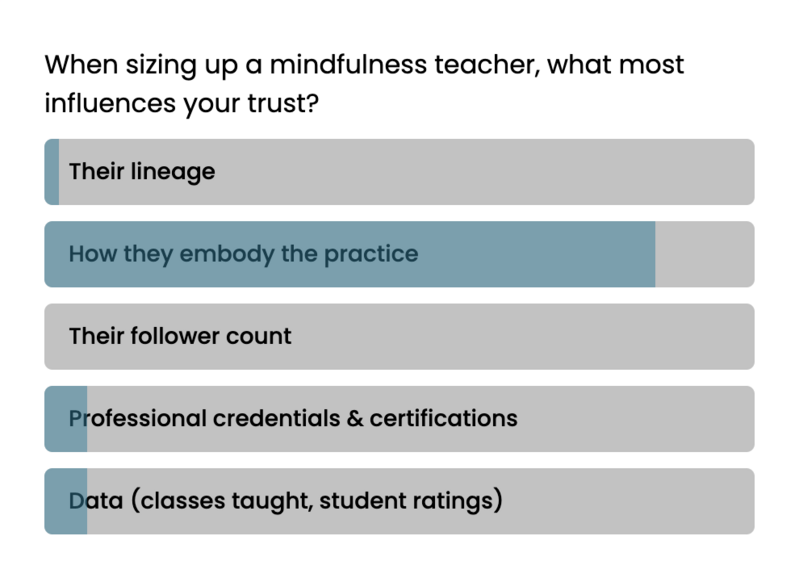
Consider the language we use. We speak of embodiment, as if wisdom were visible in posture and presence. Some invoke lineage, chains of connection stretching back to enlightened gurus. Some reference transmission, the ineffable passing of insight from teacher to student. Even movements that define themselves as secular often reproduce the same prestige hierarchies under a different language and a different guise.
I remember a conference several years back. I was standing near the registration table when a teacher I respect walked past. Two participants literally whispered to each other, She studied directly with Kabat-Zinn. That was the whole sentence. It functioned as a complete credential. No mention of her research, her teaching skill, her actual contribution to the field, how many classes she taught, how many students, or how long. Just proximity to a famous name.
Here's what I'm not proud of: my own estimation of her shifted slightly in that moment. Not because I learned anything substantive. Because the prestige signal landed.
Watch what happens at these gatherings. Speakers rarely focus on the impact of their work. They focus on their “lineage” and name-drop. I studied with Thich Nhat Hanh. I sat with Joseph Goldstein. Jon Kabat-Zinn endorsed my program. The implicit message is clear: authority flows downhill from the famous. Proximity to recognized teachers becomes its own credential.
Participants interpret teachers through the same filters that distort perception everywhere else. Composure becomes depth. Confidence becomes clarity. Articulate speech becomes insight, even when the insight is thin. Institutional affiliation becomes legitimacy. Lineage, real or implied, becomes the trump card that settles questions before they're asked.
Teachers are granted epistemic authority long before participants have grounds for evaluation. This isn't a moral failure. It's a predictable consequence of how minds resolve uncertainty. Prestige signals simplify perception. Projection fills the gaps.
Ironically, practices devoted to examining the constructed nature of the mind are stewarded within systems that continuously manufacture prestige and authority. Attention training doesn't dismantle status perception. Awareness doesn't confer immunity. To be clear, I've been meditating for over two decades. I still catch myself doing this. It's natural. It's how we are wired.
From Critique to Architecture
If prestige invariably distorts perception, then the question we’ve got to ask is, how can we proactively counteract the effect?
I'm genuinely fascinated by how the Quakers approached this problem. They built their entire practice around collective discernment rather than charismatic leadership. No clergy. No hierarchy of spiritual attainment. Decisions emerge from the group sitting together in silence, waiting for clarity. It's radically different from how most mindful communities operate. I think they understood something critically important about the risks of concentrated authority.
In practice environments like theirs, legitimacy rests less on persona and more on participation. Authority diffuses. The gravitational pull of a performative guru-like identity weakens.
No structure eliminates bias. Structures change bias. This is one of the ideas underlying Open MBSR. Practice doesn't require prestige scaffolding or charismatic authority structures. Stability can emerge from shared method, communal inquiry, and direct engagement with experience. The shift from teacher-centered to facilitator-centered approaches. The teacher is not an embodied, transmitting, enlightened superhuman with a superior brain. The focus is on the teaching and the community. The teacher is not supernaturally nor neurobiologically special (sorry). They are still a human that may pick their nose and definitely farts.
When authority becomes functional rather than symbolic, something changes. Teachers become facilitators of process rather than power centers of projected wisdom. The question shifts from "Who should I follow?" to "What practices actually work?"
The Deeper Challenge
Prestige disruptions are easily framed as moral dramas. Good people revealed as flawed. Trusted figures exposed as frauds. This framing misses the point. These events are cognitive events. Human perception behaves exactly as it always has. It relies on shortcuts, resists dissonance, and revises models only when forced.
Nothing exceptional is occurring.
The deeper challenge for the mindfulness field isn't simply ethical. It's architectural. Which structures amplify prestige distortions, and which dampen them? Which arrangements foster dependency, and which cultivate genuine autonomy?
Despite good intentions, current approaches often create dependency rather than liberation. Through my course, my teaching, and my app, you will find liberation. Really? They concentrate power and prey on people's desires and insecurities. These patterns aren't inevitable. They're design choices, and it doesn’t have to be like this.
The answer shapes far more than reputations. It shapes how wisdom itself is perceived, how it gets transmitted, and whether students ever develop the capacity to practice without needing a teacher's validation.
What I'm Still Sitting With
I don't have a tidy conclusion here. The path forward requires clear-eyed recognition of these dynamics and the courage to build differently. But I'm writing this as someone with a platform, with institutional credibility, and with my own version of the prestige scaffolding I'm critiquing.
The question is whether we'll keep building systems that amplify power and prestige or create something different. I'm voting for different.

Comments