

By Mo Edjlali, Founder of Mindful Leader; Author, Open MBSR
Apolitical is a principle. Amoral is a failure.
The mindfulness field teaches people not to look away. Then a war comes. And the field looks away.
On February 28th, a missile hit a girls' school in southern Iran. 170 people were killed. Many of them were children. That was day one of the war.
That was five weeks ago.
Since then, we've had missiles hitting civilian targets in half a dozen countries. The Strait of Hormuz shut down. Gas at over $4 a gallon. A U.S. pilot shot down and evading capture behind enemy lines. Churches in Dubai moving services online because it's too dangerous to gather. Before all of this, we had over two years of Gaza. Tens of thousands of civilians dead. Hospitals flattened. The ICC issuing war crimes charges. Famine.
The Pope called for peace on Easter. Israelis took to the streets in Tel Aviv demanding the war end. Human Rights Watch investigated the school bombing. Educators across the country are trying to figure out how to talk to kids about what's happening.
And the mindfulness field?
Go look. I'm serious. Pull up the feeds of the biggest mindfulness organizations in the world right now. Check the blogs. Search for any kind of statement from the meditation apps with tens of millions of users.
The wisdom of embodiment. Practices for inner peace. Sending some Metta your way.
Nothing.
Apolitical Is Not Amoral
I need to be upfront about something, because it might seem I've been making the opposite argument for years. I believe the mindfulness field should be apolitical. I've argued that when mindfulness communities become vehicles for partisan ideology they alienate the people who need the practice most. I've called out the field's quiet — and sometimes blaringly loud — alignment with progressive politics. I've said that the absence of conservatives and Republicans in our spaces isn't an accident. It's something we created.
I still believe all of that.
But I have to draw a line I haven't drawn before. Being apolitical means you don't tell your community what to think about the war. Being amoral means you don't acknowledge that people are being killed and dying in one. Those are not the same thing.
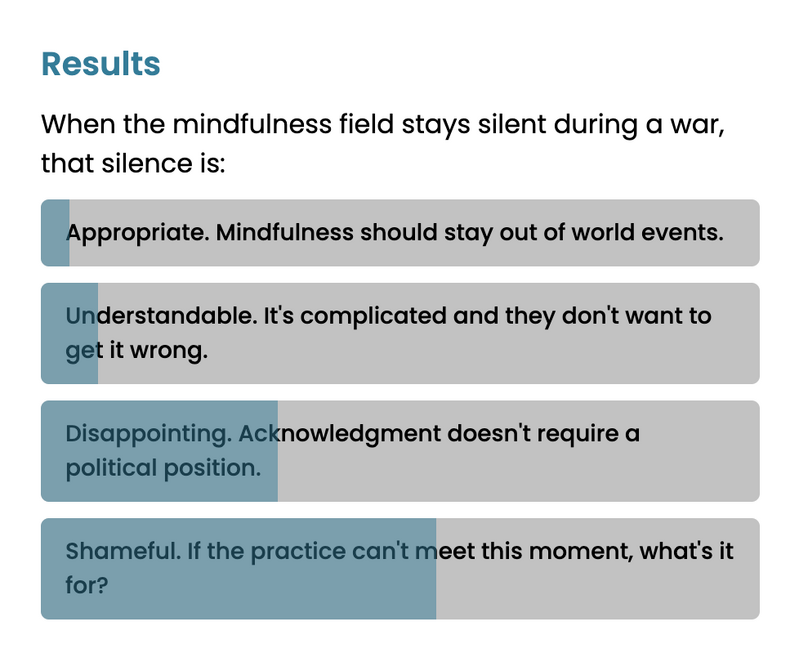
And what the mindfulness field has been doing, since Gaza and now through five weeks of the Iran war, is not apolitical. It's amoral. And we should be ashamed.
The Receipts
Let me be specific.
When Gaza erupted in October 2023, the major commercial platforms said nothing. Headspace. Calm. Ten Percent Happier. No statements. No acknowledgment. No resources for the millions of practitioners trying to sit with what they were seeing on their screens every day. The content calendars kept running. Sleep. Stress. Inner peace. Embodiment. Compassion. Productivity. The big meditation centers were mostly quiet too.
A Dutch Vipassana teacher named Frits Koster eventually wrote about this in a piece called "Silence is Not Always Golden." He pointed out that the Buddhist and secular mindfulness worlds had been almost completely absent throughout the war. His words: complicity through negligence.
There were exceptions, and I want to name them. The Plum Village community engaged. A practitioner at Deer Park Monastery wrote honestly about shame and not knowing what to do. The Sati Center hosted a real conversation between a Palestinian dharma teacher and an Israeli one. Those were courageous. But they were outliers. The organizations and teachers with the biggest audiences, the most resources, the most influence? Nothing.
Then the Iran war started. And somehow the silence got louder.
I've searched. I've looked. I cannot find public statements from any major mindfulness organization about this war. Not Spirit Rock. Not IMS. Not the big university-based mindfulness training centers. Not the teachers with the largest followings. Five weeks into a conflict that has shut down a global shipping lane, put missiles in the skies over multiple countries, and has millions of people carrying anxiety at levels they've never experienced.
And the institutions that exist to help people meet difficult moments? They're posting about how to stay happy.
The Bar Is Lower Than You Think
I know the objection. I can already hear it. "We're not foreign policy experts. We don't want to say the wrong thing. It's complicated."
Fine. I understand that. But here's what bothers me. Nobody is asking Calm to negotiate a ceasefire. Nobody expects the Insight Meditation Society to publish a white paper on Iranian nuclear capabilities. The bar is so much lower than that.
The bar is: acknowledge that your community is in pain. Acknowledge that something enormous is happening in the world. Acknowledge that the anxiety people are bringing to their practice right now isn't about their morning commute. It's about a war.
You don't need a position on the Strait of Hormuz to say: "We see what's happening. We know many of you are struggling with this. Here's how practice might help you meet this moment."
That's it. That's the whole ask.
And the fact that you can do that without being partisan — that you can say "children were killed in a school bombing" without endorsing a political candidate — makes the silence even worse. It means the field isn't staying quiet because it's impossible to speak. It's staying quiet because it's easier.
It's Not Apolitical. It's Commercial.
Why? If it's possible to respond without being political, why doesn't the field do it?
I keep coming back to the same answer. The business model.
When your revenue depends on corporate wellness contracts, you learn not to say things that make HR departments nervous. When your subscriber base is broad, you avoid anything that might cause cancellations. When your brand promise is calm or happier, you don't introduce the opposite.
So the silence isn't really apolitical. It's commercial. It protects revenue by stepping around the moral question entirely.
I've been writing about the mindfulness spiritual industrial complex in this series for six years. The commercialization. The optimization for comfort. The avoidance of anything hard because hard doesn't convert. But I didn't think I'd see it tested like this. I didn't think I'd watch an entire industry that teaches people not to look away collectively look away from a war.
A Cognitive Ceiling, Not Equanimity
I read an article a few days ago that I haven't been able to shake. A psychology piece that argued people feel eerily calm about the war not because they've thought it through and decided it's fine, but because their brains can't actually model the cascading personal consequences of a major military conflict. The brain hits its limit and mistakes that limit for an answer. Your calm isn't safety, the author wrote. It's a cognitive ceiling.
I keep wondering if that's what's happening in our field. Whether what looks like equanimity is actually just the inability — or the unwillingness — to fully face what's happening. And whether the practice itself, the way we've been teaching it, the way we've commercialized it, has made that avoidance easier rather than harder.
That's a disturbing thought for someone who has spent over a decade helping teach this work.
I've Been Silent Too
I have to be honest about my own position, because without it this is just finger-pointing from a safe distance.
I'm Iranian American. This war isn't abstract to me — I have family, roots, and connections to the people on the receiving end of those strikes. I also run the world's largest MBSR provider. I'm not writing this as an outsider lobbing criticism. I'm writing as someone inside the field who loves this work.
And someone who has been silent too.
When Gaza erupted in October 2023, I was horrified. Then I got numb. It was far away. I had a business to run. I told myself we were apolitical and hid behind it — afraid of being called partisan, afraid of religious accusations from one side or the other, afraid of what speaking would cost.
There was a moment on one of our Meditate Together sessions when a member checking in from Ramallah started to share what was happening where she was. And I'm ashamed to write this — part of me didn't want to hear it. Not because I didn't care. Because I did, and I knew if I let it in I'd have to do something. I've drafted versions of this article for over a year. I never published them.
What changed is that the war came closer. I've stayed quiet when every bone in my body wanted to shout. I'm done with that.
So when I criticize the field's silence, understand that I'm criticizing my own too.
What I'm Actually Asking
So here's what I'm asking. And it's less than people might think.
I'm not asking mindfulness leaders to become war correspondents. I'm not asking for geopolitical hot takes from meditation teachers. I'm not asking anyone to abandon the apolitical principle I've spent years defending.
I'm asking for honesty.
- If you're silent because acknowledging the war might cost you subscribers, just say that. At least it would be real.
- If you're silent because you don't know what to say, I get it. But "I don't know what to say and I see the suffering" is a thousand times better than pretending nothing is happening.
- If you're silent because your business model requires you to never make anyone uncomfortable, then maybe it's time to ask whether that model is compatible with the values you claim to teach.
Because there's a real tension between selling people the ability to face difficult emotions and then refusing to face the most difficult situation on the planet.
You can acknowledge civilian suffering without picking a side. You can make space for your community to process what they're going through without telling them what to think. You can say "a school was bombed" without telling people who to vote for.
What Are We Actually Teaching?
And if the practice can't do that? If it can't meet a moment like this? Then I think we have to ask a harder question.
What exactly are we teaching people to do?
The mindfulness field teaches people to sit with what's uncomfortable. To face what's real. To not turn away.
And then a war comes. And the field turns away.
We should be ashamed. Not because we didn't stop the war. But because we couldn't bring ourselves to say the word.
Apolitical is a principle. Amoral is a failure. And the mindfulness field owes its community — and itself — an honest reckoning with which one it's been practicing.

Comments