

By The Mindful Leader Team
A new debate in the Journal of Organizational Behavior asks a simple question: Does mindfulness benefit the workplace?
Gwendolin Sajons and John Antonakis say the evidence is unclear. Darren Good, Christopher Lyddy, and Kirk Warren Brown respond that the answer is clear.
Same question. Two very different assessments of the science.
A third paper, an editorial by Marie Dasborough and Changmeng Xu, steps back from the disagreement and asks what may be the larger question: How much evidence is enough before organizations put an intervention into practice?
The exchange is the latest chapter in a debate that has been unfolding for more than a decade. Both sides cite earlier critiques of mindfulness research, including the influential 2018 paper Mind the Hype, which warned against allowing enthusiasm for mindfulness and meditation to outrun what the science could support.
Disclosure: Mindful Leader provides mindfulness training and education, so we have a professional interest in this debate. We also have existing relationships with two authors of the counterpoint: Darren Good and Christopher Lyddy have previously spoken at the Mindful Leader Summit. We have tried to represent both sides of the exchange fairly.
Rather than treating these as three unrelated papers, we’ll follow the debate as it appeared: point, counterpoint, and synthesis.
1. The Point: Is the Evidence for Mindfulness at Work Strong Enough?
Journal of Organizational Behavior, 2026, published online summer 2026
Gwendolin B. Sajons, ESCP Business School, and John Antonakis, University of Lausanne
DOI: 10.1002/job.70110
Workplace mindfulness is frequently described as evidence-based. Sajons and Antonakis challenge how confidently we can make that claim.
Their position is not that mindfulness has been shown to be ineffective. It is that much of the organizational research used to support mindfulness cannot establish whether mindfulness itself caused the benefits attributed to it.
The authors examined mindfulness research published from 2010 through July 2023 in a group of leading management and applied psychology journals. Their examination of intervention research included 21 experimental studies. They identify six recurring concerns: correlational studies that cannot establish causality, weak tests of how mindfulness produces effects, heavy reliance on self-report, self-selected participants, inadequate comparison groups, and reviews that may amplify findings from methodologically limited studies.
Their larger argument is that organizations have embraced mindfulness faster than organizational science has established exactly what it does, for whom, and how it compares with other ways of improving employee well-being.
Key Findings
- Correlation is often doing more work than it should. More mindful employees may report better sleep, less burnout, better work-family balance, or stronger performance. But they may also differ in personality, emotional disposition, cognitive ability, workplace conditions, or other characteristics that contribute to those outcomes. The authors argue that many observational studies cannot adequately separate these possibilities.
- Mindfulness frequently gets compared with doing nothing rather than with doing something else. If employees taking a mindfulness course improve relative to a waitlist, the benefit could come from meditation—but also from receiving attention, taking time away from work, relaxing, expecting improvement, or participating in a structured wellness activity. The authors compare this to recommending an expensive medication without knowing whether a cheaper treatment might work equally well.
- Self-report remains dominant. Of the 12 experimental studies in their sample published before 2020, eight relied exclusively on self-reported outcomes. Of the nine published afterward, eight did. The authors argue for more behavioral, physiological, and independently measured outcomes.
- There is at least one methodological bright spot. Ten of the 12 earlier studies used invitation-based self-selected samples, compared with three of the nine later studies. The improvement is smaller if online samples are also treated as self-selected, but the authors’ own analysis suggests progress in this area.
- Stronger comparisons can produce smaller effects. The authors point to a 2021 meta-analysis of 136 randomized mindfulness trials outside the workplace literature in which some effects weakened or disappeared when mindfulness was compared with particular active treatments or when analyses focused on studies with lower risk of bias. They ask whether workplace findings might change similarly under more rigorous testing.
This paper does not demonstrate that workplace mindfulness is ineffective. It challenges what organizations and practitioners can confidently infer from the existing workplace literature.
If a mindfulness program reduces stress compared with doing nothing, that is useful information. But it does not tell an employer whether mindfulness is more effective than exercise, workload reduction, flexible scheduling, another stress-management intervention, or simply taking a daily walk.
For practitioners, the central warning is about the distance between an encouraging association and a strong causal claim. Sajons and Antonakis want better comparison groups, more objective outcomes, more representative samples, stronger causal methods, and greater restraint when translating research into promises about what mindfulness will accomplish.
2. The Counterpoint: Is the Evidence Stronger Than the Critics Suggest?
Journal of Organizational Behavior, 2026, published online summer 2026
Darren J. Good, Pepperdine University; Christopher J. Lyddy, Providence College; and Kirk Warren Brown, Carnegie Mellon University
DOI: 10.1002/job.70112
Good, Lyddy, and Brown agree that mindfulness research should become more rigorous. What they reject is the conclusion that the evidence for mindfulness at work is therefore weak.
Their first objection is scope. Sajons and Antonakis concentrate largely on mindfulness research appearing in a relatively small group of management and applied psychology journals. Good and colleagues argue that doing so leaves out decades of relevant research from psychology, neuroscience, medicine, and contemplative science.
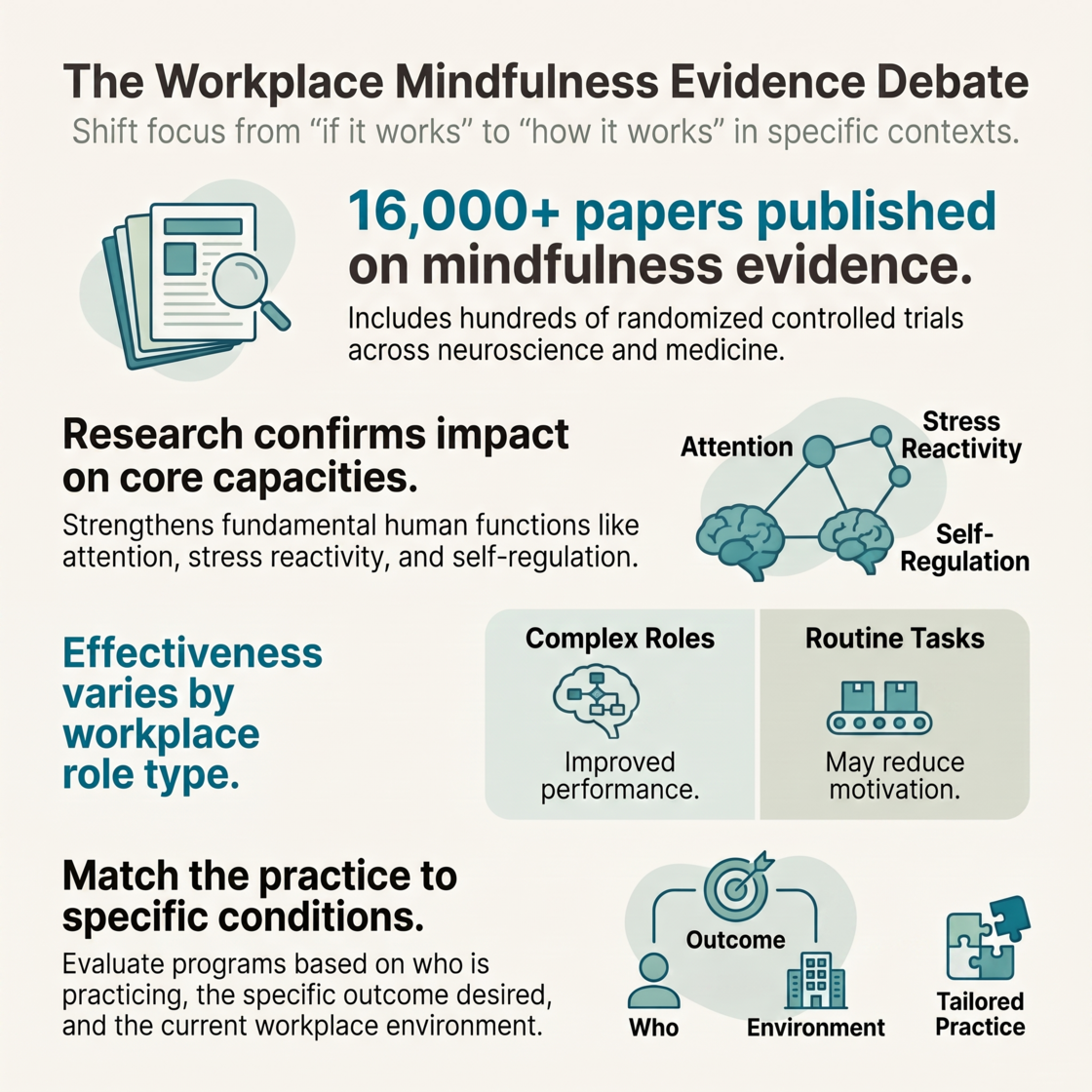
By 2021, more than 16,000 mindfulness papers had been published, according to a bibliometric analysis they cite, including hundreds of randomized controlled trials and neuroscience studies. Their argument is not that all this research tells us exactly what happens in a workplace. Rather, findings showing that mindfulness affects basic human capacities such as attention, stress reactivity, and self-regulation should be part of any assessment of whether mindfulness has value at work.
The authors also push the debate in a different direction. Rather than continuing to ask simply whether mindfulness works, they argue that researchers need to understand how mindfulness interacts with actual workplace conditions—a direction they are developing under the banner of Contemplative Management Theory.
Key Findings
- The evidence extends beyond workplace questionnaires. The authors highlight randomized research in which brief mindfulness training was compared with an active relaxation condition and produced changes in objective attention performance, stress hormones, and brain activity related to self-regulation. They also cite follow-up research in which mindfulness training reduced smoking even though participants were not trying to quit.
- Mindfulness may already be unusually well tested by organizational-research standards. Good and colleagues searched the same leading organizational journals across 13 years and found only 11 articles that substantively discussed active controls or comparative efficacy; three were mindfulness papers. Their argument is that some of the standards Sajons and Antonakis demand would represent a methodological upgrade for organizational behavior generally, not merely mindfulness research.
- Self-selection creates a real problem without an easy ethical solution. Workplace mindfulness studies often involve people who choose to participate, but randomly forcing employees into meditation training would be ethically and practically problematic. The counterpoint argues that real-world organizational research has constraints that ideal experimental prescriptions need to recognize.
- Mindfulness can sometimes make things worse. The authors highlight studies in which mindfulness reduced motivation for routine tasks and others where greater mindfulness appeared to amplify the effects of abusive supervision, emotional labor, anxiety, or loneliness. More awareness is not automatically more comfortable or more beneficial.
- Context can change the result. In one study of nuclear power plant workers, mindfulness predicted better performance among control-room operators performing complex work but not among field workers doing less complex tasks. In another study, police officers showed greater increases in mindfulness when they perceived social norms as supportive of the training.
The most interesting part of the counterpoint may be that its authors do not simply argue that mindfulness works.
They argue that the field needs to become considerably more specific about when it works.
This is where their emerging Contemplative Management Theory becomes relevant. Good and Lyddy want researchers to better integrate mindfulness with theories of organizational cognition and behavior: How does mindfulness affect complex decision-making? Receiving negative feedback? Emotional labor? Attention? Motivation? How do workload, supervisor support, organizational culture, job control, and social norms change its effects?
That is an important shift for practitioners. The same meditation practice may function differently for a control-room operator performing cognitively demanding work than for someone completing repetitive tasks. A program supported by an organization's culture may function differently from one employees experience as another corporate mandate.
The question becomes less “Does mindfulness work?” and more “What kind of mindfulness, for whom, doing what, and in what environment?”
3. The Editorial: How Much Evidence Is Enough?
Journal of Organizational Behavior, 2026, published online summer 2026
Marie T. Dasborough, University of Miami, and Changmeng (Melody) Xu, Dongbei University of Finance and Economics
DOI: 10.1002/job.70111
Dasborough and Xu do not introduce another study or attempt to declare a winner. Their editorial steps back from the point-counterpoint exchange and asks what the disagreement tells us about how science moves into practice.
They describe mindfulness as occupying an unusual position: scientifically promising, philosophically rich, widely commercialized, and increasingly scrutinized.
Both sides agree that employee well-being matters and that better research is desirable. The disagreement is over how strong the current evidence already is and what level of uncertainty should prevent—or permit—organizations from acting.
Key Findings
- The debate is partly about different standards of evidence. Sajons and Antonakis emphasize whether individual workplace studies can isolate causal effects and rule out plausible alternatives. Good, Lyddy, and Brown place more weight on evidence converging across disciplines, methodologies, populations, and outcomes.
- Scientific rigor and practical usefulness do not always point in the same direction. The editors describe the disagreement as reflecting broader tensions between “rigor versus relevance” and “causality versus practicality.”
- Organizations rarely make decisions with perfect evidence. The practical question is whether relatively promising but imperfect evidence is sufficient to justify an intervention—or whether researchers should withhold recommendations until stronger causal evidence exists.
- The two sides share more ground than their opening sentences suggest. Neither side argues that organizations should ignore employee well-being, and both support continued research. Their disagreement is principally about how much confidence the present evidence warrants.
For mindfulness professionals, the editorial exposes an important distinction:
“There is evidence supporting mindfulness.”
and
“This mindfulness program will produce this outcome for these employees.”
Those are different scientific claims.
The first can draw upon a broad interdisciplinary literature. The second requires much more specific evidence about the intervention, participants, organizational setting, desired outcome, and the alternative against which mindfulness is being compared.
Organizations will rarely have perfect information. But incomplete information does not require either dismissing mindfulness or overstating what the evidence shows.
What should we take from this?
The disagreement is not really about whether there is evidence behind mindfulness. There is. The harder question is what that evidence allows us to claim.
Good, Lyddy, and Brown argue that workplace mindfulness should be understood in light of decades of research across psychology, medicine, neuroscience, and contemplative science. Sajons and Antonakis make an equally important distinction: evidence supporting mindfulness generally does not establish that a particular workplace program caused a particular outcome, will work across an entire workforce, or is better than another intervention.
We reached out by email to Christopher Lyddy and Darren Goodt. Lyddy pointed toward where the research may need to go next:
“If we had a better understanding of mindfulness specifically in the workplace context, we believe this would help to reduce the uncertainties they find concerning.”
For mindfulness professionals, that points to a more precise set of questions: What practice? For whom? Toward what outcome? Under what conditions? Compared with what alternative?
“There is evidence supporting mindfulness” and “this program will produce this outcome for these employees” are very different claims. Our field has not always been careful about the distance between them.
That should be a higher standard not only for researchers, but for those of us teaching and providing mindfulness-related products and services.
This article is part of our Research & Trends Series where we share the latest research and studies shaping our field.

Comments