
By The Mindful Leader Team
Wellness Trends Impacting Mindfulness, Meditation & Workplace Mental Health
Four major reports, from Wellable, the Global Wellness Summit, Gartner, and Lyra Health, were analyzed for our Spring Pulse Report. Taken together, they tell a coherent story: the mental health crisis in the workplace has crossed a threshold. It is no longer primarily a stress and burnout story. It is a severity story. Complex psychiatric conditions, disability leaves, and AI-driven anxiety are rising simultaneously, while the systems meant to address them - managers, benefits programs, wellness apps - are visibly failing to keep up.
The market is responding with a hard turn toward clinical grounding. Employers are pulling investment away from app-based and legacy wellness programs and redirecting it toward evidence-based, outcomes-driven care. AI wellness tools are being evaluated cautiously, with employer trust still low. The over-optimization era of performance wellness is facing a cultural backlash, with consumers moving toward connection, meaning, and nervous system regulation.
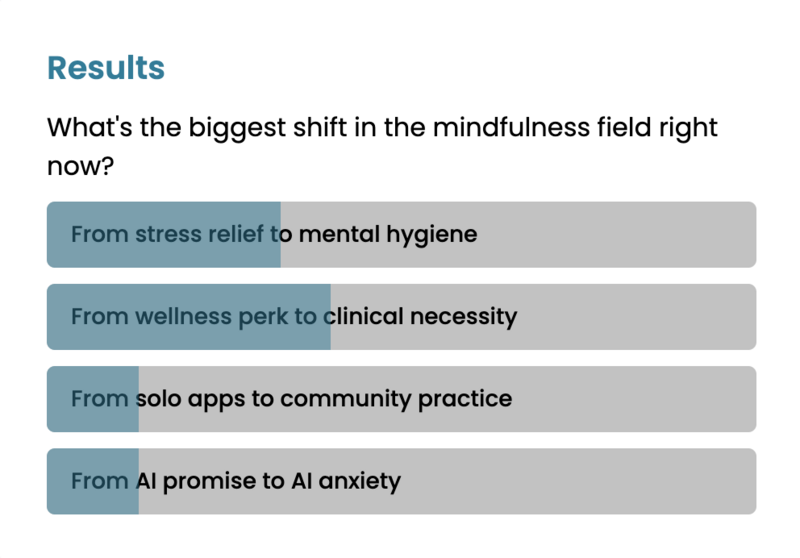
In January, we published 4 Trends Shaping Mindfulness in 2026, identifying frazzled minds seeking daily mental hygiene, eroding impulse control in an environment of boundless temptation, chronic nervous system dysregulation as the new baseline, and the failure of individualistic self-care to address a deepening loneliness epidemic. The external research validates all four. The data shows people are arriving at practice — and at work — already dysregulated, already depleted. The prescription for solo wellness apps is losing credibility. The case for communal, evidence-based, human-led programs has rarely been stronger.
Wellable 2026 Employee Well-Being Industry Trends Report
Source: 2026 Employee Well-Being Industry Trends Report
Publisher: Wellable LLC, 2026 (specific date not publicly disclosed)
Survey: Annual survey of health insurance brokers and wellness consultants across the US, representing thousands of employers and millions of employees. Sample size not disclosed for 2026; 2025 edition surveyed 129 brokers across 25 states. Ninth annual edition.
The broker-side view of what HR buyers are spending money on and why. The 2026 edition marks a clear inflection — the language has shifted from "wellness programs" to "clinically grounded benefits," and the data reflects it. Legacy offerings like biometric screenings and on-site fitness classes are declining. Mindfulness as a standalone category is losing ground. What's rising is outcomes-focused, evidence-based care paired with manager training. The framing maps closely onto Mindful Leader's positioning.
Key Takeaways
- Mental health leads investment for the seventh consecutive year — but the market wants clinical grounding, not branded relaxation. 76% of employers are increasing mental health spending. The report's framing has shifted decisively: employers are moving away from standalone EAPs and mindfulness apps toward tiered support models, manager training, and stress and resilience resources. Evidence-based MBSR is well-positioned against app-based mindfulness precisely at the moment the market is demanding the distinction.
- Awareness is the #1 barrier to engagement — not stigma. 73% of brokers cite lack of employee awareness of available programs as the top barrier, ahead of cost (62%), difficulty accessing services (51%), and stigma (49%). The engagement problem isn't resistance — it's invisibility.
- AI wellness is arriving — but trust is the gap. 30% of brokers are actively recommending AI-powered wellness solutions and another 65% are considering it. But employer concerns remain significant: 78% worry about data privacy, 70% cite lack of trust, and 58% flag compliance uncertainty. Human-led, evidence-based programs hold a credibility advantage in this window before AI wellness establishes trust.
Global Wellness Summit: Future of Wellness 2026
Source:The Future of Wellness: 2026 Trends
Publisher: Global Wellness Summit (GWS), January 27, 2026
Survey: Expert synthesis by hundreds of global health and wellness experts — not a traditional survey. Each of 10 trends is authored by a designated writer selected by GWS. Sponsored by Amway.
GWS covers the consumer wellness landscape — spa, longevity, lifestyle. But two of its 2026 trends land squarely in Mindful Leader's territory. The over-optimization backlash names exactly what Mindful Leader's founding critique has always been. And the neurowellness trend puts mainstream language around nervous system regulation that MBSR has always practiced but rarely named in those terms. This is the cultural signal, not the employer signal — and it's moving in the same direction.
Key Takeaways
- The over-optimization backlash validates everything Mindful Leader was built on. Consumers are rejecting hyper-tracked, performance-obsessed wellness in favor of social, somatic, and emotionally grounding practices. GWS describes a pivot toward emotional repair, pleasure, meaning, and human connection. MBSR's non-striving, non-judgmental orientation isn't swimming against the current anymore — it is the current.
- Neurowellness is the new mainstream framing for what mindfulness actually does. GWS identifies nervous system regulation — not stress reduction — as the next wellness frontier. The fight-or-flight dysregulation framing and somatic practices as nervous system tools are going mainstream. This maps directly onto the "tired and wired" trend Mindful Leader identified: people arriving at practice already dysregulated, needing help downshifting before they can even begin. Adopting some of this language may improve accessibility with new audiences.
Gartner Future of Work Trends for CHROs 2026
Source: Gartner Identifies the Top Future of Work Trends for CHROs in 2026
Publisher: Gartner, Inc., January 12, 2026
Survey: Gartner proprietary research synthesis — in-depth studies, trend analysis, and quantitative modeling. Authors: Emily Rose McRae, Senior Director Analyst; Kaelyn Lowmaster, Director, Gartner HR Practice. No single survey sample size disclosed for this report.
Gartner speaks directly to CHROs — the people who authorize workplace mindfulness programs. Naming AI-related psychological injury as an emerging category requiring a CHRO response plan is significant language from a conservative analyst firm. Combined with the culture dissonance and regrettable retention framing, it builds a business case for mindfulness investment that is entirely separate from wellness theater.
Key Takeaways
- AI is creating a new category of psychological harm at work. Gartner names "employees' mental fitness" as AI's biggest hidden cost in 2026, citing disordered AI use, anxiety about job displacement, and skill erosion. Only 1% of layoffs in H1 2025 were actually caused by AI productivity gains — yet workers are experiencing mounting psychological uncertainty. CHROs are specifically advised to have a plan for "AI-related psychological injury." This is a fresh, defensible use case for mindfulness training that doesn't rely on the worn burnout pitch.
- Culture dissonance and regrettable retention are the underlying crisis. Organizations are demanding more without offering more in return. The result isn't mass resignation — it's what Gartner calls "regrettable retention": people staying while quietly deteriorating. This maps onto Mindful Leader's framing of self-care as necessary but not sufficient: individual coping practices can't compensate for structural disconnection. Programs addressing relational dynamics and psychological safety at the organizational level are what this moment calls for.
Lyra Health 2026 Workforce Mental Health Trends Forecast
Source: 2026 Workforce Mental Health Trends Forecast
Publisher: Lyra Health, November 11, 2025
Survey: Sixth annual survey of 500+ HR and benefits leaders at US-based organizations with global workforces (500 to 90,000+ employees), conducted July 17 – August 9, 2025. Sectors include healthcare, retail, IT, finance, manufacturing, and the public sector.
The most granular and clinically grounded of the four reports. Lyra draws on longitudinal case data from its own platform, so its severity numbers aren't survey opinion — they're case volume. The leave wave, the manager span-of-control data, and the AI paradox findings all point to a system that has quietly crossed a threshold. The frazzled mind, tired and wired, and impulse-control trends Mindful Leader named are showing up here as clinical data, not cultural observation.
Key Takeaways
- The crisis has crossed from burnout into clinical severity. 65% of benefits leaders report rising mental health-related disability leaves. Complex conditions — severe depression, suicidality, trauma — are up 88% year over year. Substance use is up 26% year over year. The share of employees beginning treatment with severe conditions has climbed 46% since 2021, from 13% to 19% of new cases. This is no longer a burnout story. The case for upstream, preventive programs like MBSR is direct and urgent.
- AI anxiety is measurable, not anecdotal. 35% of HR and benefits leaders say AI is already driving employee stress and job anxiety. Only 23% expect it to improve work-life balance. Critically, 98% believe employees should have a choice between human and AI-enabled care, and 96% say AI should support — not replace — human providers. Human-led care retains a strong and explicit credibility premium in the employer market right now.
- Managers are structurally overwhelmed. 96% of benefits leaders say managers are integral to mental health strategy, but the average manager's span of control has tripled — from 1:5 in 2017 to 1:15 in 2023. Nearly 9 in 10 say managers are expected to handle mental health crises without adequate training. 95% believe they need more support than they're currently getting.
This article is part of our Research & Trends Series where we share the latest research and studies shaping our field.

Comments