

A practical reflection framework for responding to conflict and crisis with clarity, courage, and responsibility
By The Mindful Leader Team
Alfred Adler, the early twentieth-century psychologist whose work on individual responsibility helped shape modern therapy, once suggested that the most important question we can ask in difficult situations is not:
"What is wrong with the world?"
But rather:
"What is my task in this situation?"
It is a deceptively simple question. And most of us are not asking it.
When global events feel overwhelming — war, humanitarian crises, polarization, information warfare — people tend to move toward one of two extremes:
Over-identification
Becoming consumed by anger, fear, or outrage.
Withdrawal
Turning away completely and doing nothing.
The mindfulness world has not always helped with this. For years, a particular strand within practice culture has quietly encouraged the second option. Do nothing. Avoid discomfort. If something feels tense, step away. What was meant as a corrective to relentless striving hardened into a passive mindfulness - where discomfort is avoided, debate is discouraged, and emotional fragility is mistaken for compassion.
You know it when you see it. The reflexive tone policing. The fear of disagreement. The belief that mindfulness means being endlessly gentle, agreeable, and calm.
But mindfulness was never meant to produce passivity.
It was meant to produce clarity, the kind that lets you act when the world demands it.
Now is not the time to shrink. It's time to rise.
R.I.S.E.
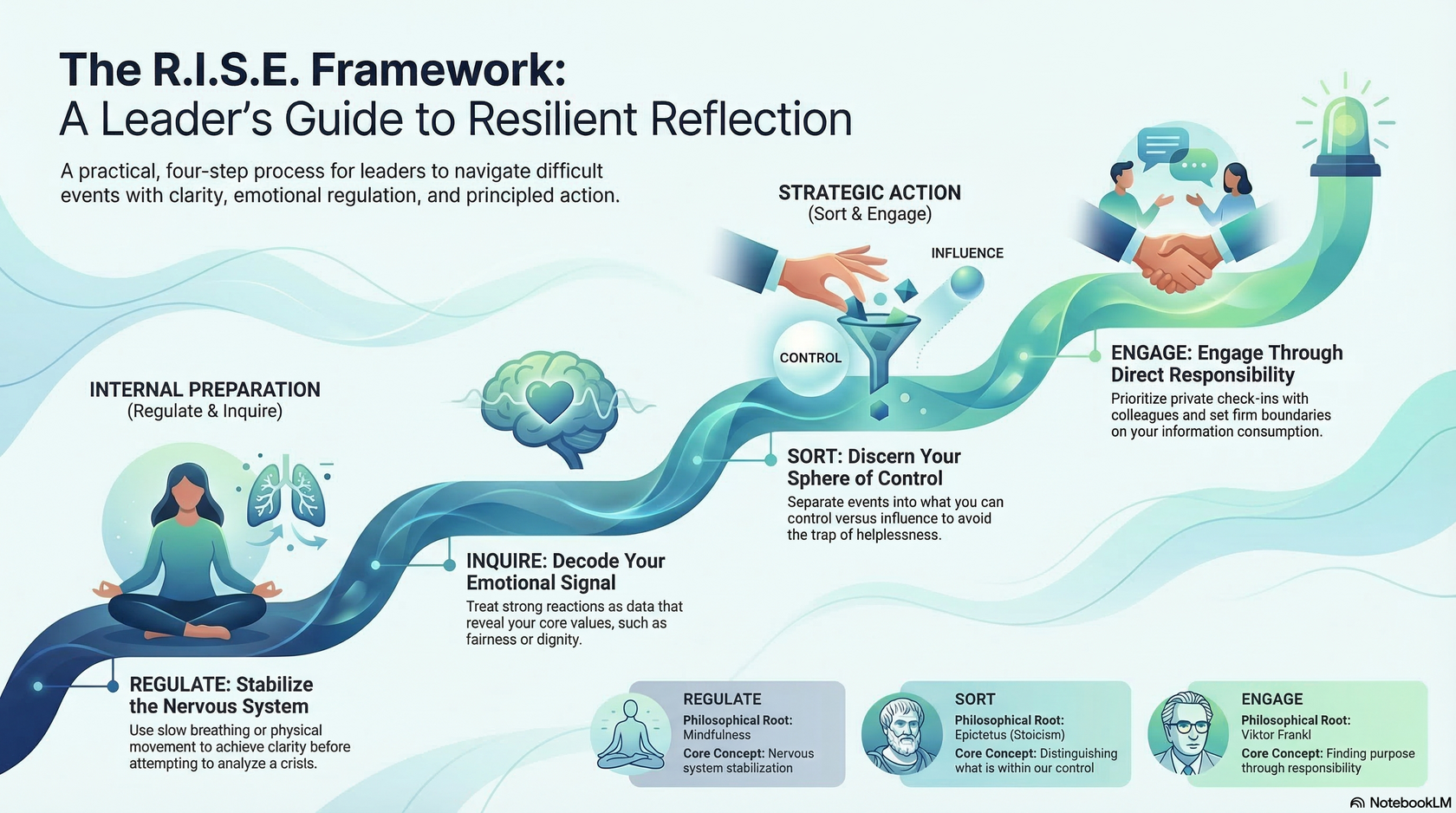
R.I.S.E. is a reflection framework for responding to difficult events with clarity and integrity, drawing on insights developed across centuries. It integrates emotional regulation from mindfulness practice; meaning-making from Viktor Frankl, whose book Man's Search for Meaning explored how people can find purpose even in extreme suffering; discernment from Epictetus, the formerly enslaved Greek philosopher who taught that freedom begins with distinguishing what lies within our control; and the reflective wisdom found in the private journals of Marcus Aurelius, whose writings became one of history’s most enduring guides to steady, principled leadership.
Together, they provide a practical path forward.
R - Regulate
Before thinking clearly, stabilize the nervous system.
You already know what an unregulated response feels like. It is 11:30 at night. You are three articles deep into a conflict you cannot influence, your chest tight, your jaw clenched, composing an argument in your head against someone who will never hear it. That is not engagement. That is activation without direction.
The first task is not analysis. It is regulation.
A few minutes of slow breathing. Stepping away from the news cycle. A short silent meditation. A walk outside. These are not avoidance; they are preparation. Clarity rarely emerges from an agitated mind.
Stability comes first.
I - Inquire
Once the mind is steadier, turn toward the reaction with curiosity.
Ask: What exactly is bothering me about this situation? What emotions are present? Why does this matter to me?
Often our strongest reactions reveal something meaningful about our values — fairness, dignity, compassion, safety, responsibility.
This is one of Frankl's core insights, that our responses to suffering often point toward what gives our lives meaning. The disturbance itself contains information. Not noise to suppress, but signal to examine.
S - Sort
Next comes discernment.
Not everything that disturbs us is something we can change. The Stoics, Epictetus especially, offered a useful mental model: separate events into what I can control, what I can influence, and what lies beyond me.
This is not resignation. It is precision.
Ask: What is actually within my sphere of ability?
This step protects against two traps — helplessness (believing nothing matters) and overreach (believing everything is your responsibility). Both lead to exhaustion. Clear boundaries restore perspective.
E - Engage
Finally, action.
Frankl emphasized that meaning often emerges through responsibility and contribution. Not grand gestures. Responsibility.
Ask: What do I stand for in this moment? What attitude do I want to bring? What constructive action is actually possible for me?
Three places to start:
1. With the people around you.
Check in — privately, specifically — with colleagues or friends who may be directly affected. Not a public post. A direct message. A phone call. The kind of support that costs attention, not visibility.
2. With your own information diet.
Set real boundaries around news and social media consumption. Not to avoid reality, but to engage it on your terms rather than the algorithm's.
3. With your language.
Resist dehumanization. In conversations, in group chats, online, refuse the framing that reduces entire populations to enemies. This is harder than it sounds and more important than most people think.
Even modest actions restore something powerful:
Agency.
The Invitation
Most people cannot influence geopolitical outcomes. But everyone can influence how they treat others, how they regulate their reactions, how they participate in conversations, and how they show up in their own communities.
Mindfulness does not ask us to withdraw from the world. It asks us to meet it — with clarity, courage, and responsibility. Can we rise to the occasion?
This article is part of our Exercises & Practices Series where we offer unique practices designed to support personal growth and professional development for you to explore and share.

Comments