

"Most people are shocked to discover they are addicted to contempt."
At our 2025 Mindful Leader Summit, Tim Shriver, CEO of the Special Olympics and co-creator of the Dignity Index, said that to a room full of mindfulness practitioners, researchers, and leaders who had gathered precisely because they cared about how we treat each other. He was joined by Marc Brackett, founder of the Yale Center for Emotional Intelligence, whose decades of research on emotional intelligence made the point land even harder.
He wasn't talking about politicians. He wasn't talking about social media. He was talking about the people in that room.
The question Shriver kept returning to wasn't about other people. It was about us. How does contempt show up in each of us?
And yes, that includes you. Inspired by his talk, here are four ways it shows up, and what you can do about it.
1. Righteous belittlement
This is contempt wearing the costume of honesty. It sounds like feedback, but it lands like a verdict on the person's worth.
That makes no sense. You should already know this. I'm just being direct. The frustration may be real. The feedback may be necessary. But there's a tell, a quiet pleasure underneath it. Not just I'm right, but I'm better. That's where disagreement ends and contempt begins.
It feels like clarity. That's what makes it dangerous. We think we're seeing things as they really are. We've actually stopped seeing the person altogether.
Try this: Before you speak, ask — Am I about to challenge this idea, or signal that I'm better than this person?
2. Bucketing people
Contempt loves a category. It's fast, efficient, and saves you the trouble of actually seeing someone.
That generation. That department. Those people. The label isn't always wrong; now patterns exist. But the label replaces the individual. Once that happens, curiosity stops. You already know who they are.
Every person is more specific, more contradictory, and more surprising than the bucket we put them in. Contempt lives in the gap between the label and the actual human being in front of you.
Try this: When a label shows up (like “this Gen Z’er”), drop it and get curious about who this person actually is.
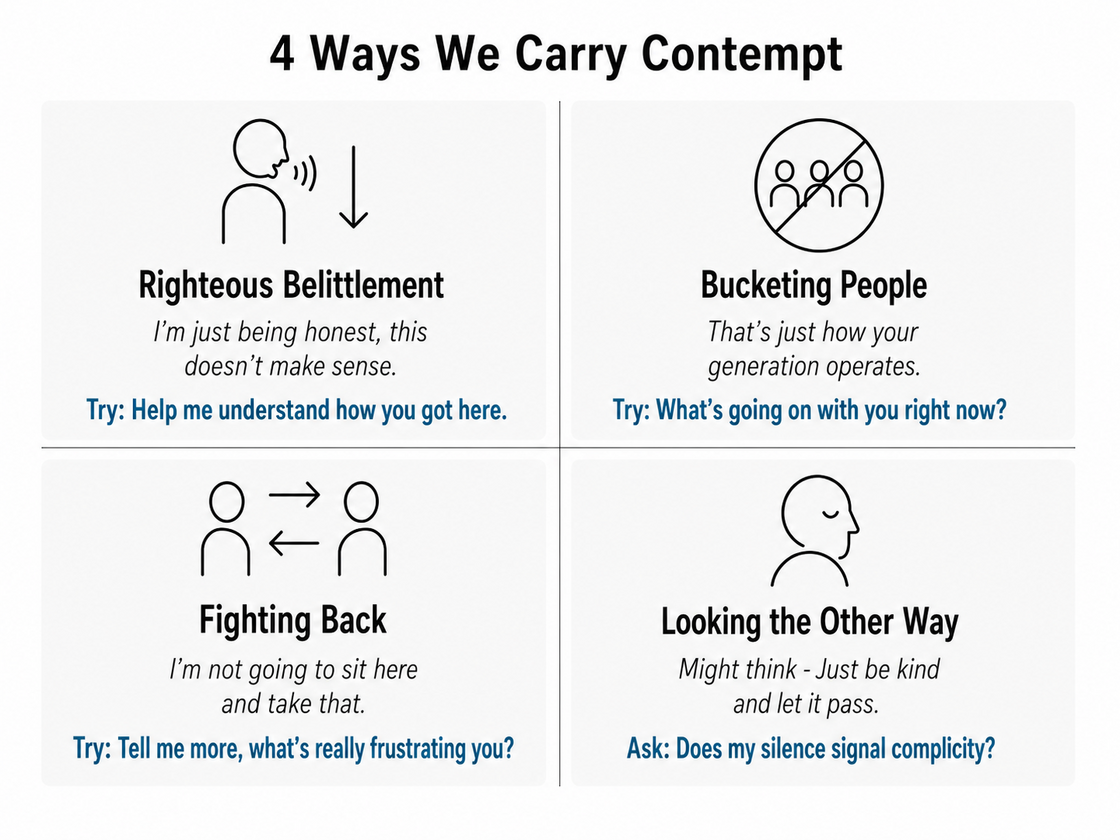
3. Fighting Back
When someone attacks us, fighting back feels not just natural, it feels deserved. They started it. This is self-defense.
But contempt fighting contempt doesn't win anything. It just pulls everyone into a dirtier version of the same conflict. Shriver's alternative is almost embarrassingly simple: Tell me more. Not as surrender — as an interruption. He once met with a group that had spent years attacking his work. Instead of a rebuttal, he said he'd been hoping to meet them and genuinely wanted to understand. They talked for nearly an hour.
Contempt was designed for a fight. When the fight isn't offered, it loses its footing. As Shriver put it, Contempt gets embarrassed when it meets dignity.
Try this: When you feel the urge to fire back, try three words first: Tell me more.
4. Looking the other way
This one is quieter than the others. No attack, no label, no sharp words. Just silence. Looking away. Letting it pass.
A colleague gets dismissed in a meeting, and nobody says anything. Someone knows they were contemptuous last week and hasn't gone back to repair it. Contempt doesn't only spread through aggression. It spreads through the unspoken signal that contempt is ok, no one is going to say anything.
It takes courage to name what's happening in the room. It takes more to go back and say, I was dismissive, and I want to acknowledge that directly. But that's what actually shifts a culture. Not the absence of contempt, but the willingness to address it when it shows up.
Try this: Think of one moment last week where contempt showed up and you let it pass — and decide if it's worth going back.
What this actually asks of us
The opposite of contempt isn't niceness. And this is where our field needs to get honest.
We have the vocabulary - compassion, non-judgment, loving-kindness. We know how to hold a calm tone. But niceness can be its own form of contempt. The teacher who responds to struggle with serene patience that quietly signals I'm beyond this. The facilitator who wraps dismissal in warmth so thoroughly you can't quite name what happened. That's not presence. That's superiority with better branding.
And then there's staying silent, letting contempt pass because naming it feels aggressive, unkind, not very mindful. That's not compassion. That's conflict avoidance dressed in spiritual clothing.
The opposite of contempt is dignity. Treating another person as fully human, even when you don't want to. Even when superiority comes wrapped in equanimity.
That's the real practice. Not eliminating the feeling, just seeing it clearly, without flinching, before it runs the show. Especially for those of us who thought we were already past it.

Comments