

By Mo Edjlali, Founder of Mindful Leader; Author, Open MBSR
Nobody sets out to become a mindful zombie. You started down this path wanting to be kinder, less reactive, a better partner, boss, or parent. Maybe you were recovering from a difficult time: a job loss, a divorce, a personal tragedy.
You signed up for a course, did a retreat, started reading or watching videos. You found something that had been missing, something that made sense, and teachers, neuroscientists, leaders, celebrities, and friends all swearing by the results. And you felt the results. They were real. You found something you didn't know was missing.
And then, somewhere along the way, it curdled. Acceptance became resignation. Letting go became burying it. Patience became complacency. Awareness became a performance of awareness. The calm set in, and so did the numbness underneath it. You started drifting into mindful zombiness.
The trouble starts when being mindful gets quietly swapped for performing mindfulness. When image becomes more important than substance, and somewhere up the chain, transcendence becomes a thing to sell.
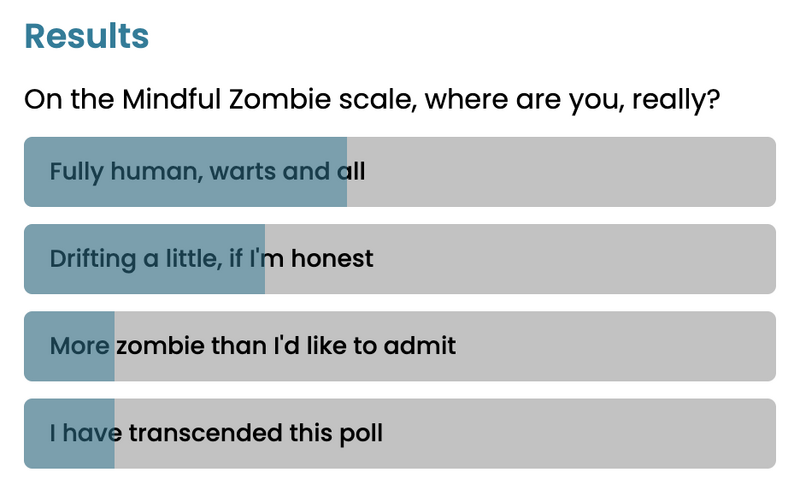
So what is a mindful zombie? Unlike the movies, they aren't undead. They're just a little less alive. They've forgotten its ok to be human, warts and all.
Are you a mindful zombie? Here are four signs to watch for.
Sign 1: Listen to how you talk
- Some words start to feel off-limits. You can't say goal (too much striving), debate (too oppositional), or WTF?! (too reactive). Spicy words become shameful and feared.
- And some become the vernacular. "Holding space." "What's alive for me." "Sitting with it." Soft, gentle, positive, trauma-informed. A vocabulary that signals you've risen above.
- Petty human-ness gets retired. Hungry? Horny? Mad? Pissed off? Master your suffering and your monkey mind would never say such pathetic, unenlightened things.
Sign 2: Watch your sense of humor die
- You start to lose the ability to take a joke. Someone teases you, and instead of laughing you hear yourself thinking, this person could really use some non-violent communication training.
- You can't make one either. Nothing dark, nothing that risks landing wrong, nothing that might offend or have a slight chance of causing suffering. And you can't laugh at yourself, because well, nonduality - there's no "you" to laugh at.
- Ordinary friction gets upgraded. A blunt email becomes "harm," a disagreement becomes "unsafe," a wrong word becomes "triggering." Everything gets heavier than it needs to be.
Sign 3: Notice you've stopped asking why
- Disagreeing starts to feel like a personal failing. Not "I think this is wrong" but "I must not be ready for it yet." Not something's off with the teacher or the teaching, but something's wrong with me for not getting it.
- You don't question the teacher anymore. You don't push on the parts that don't add up, and you get a little uncomfortable when someone else does. The questioning muscle goes limp, and any sign of challenge starts to feel hostile and beneath you.
- Something has been lost. The words differ slightly from person to person, but the same phrases, the same pauses, the same careful discoveries keep surfacing. Everyone swears they're having a direct, personal experience. They're all having the same one, the curated echo-chamber one.
Sign 4: Humbly above it all
- Other people still have egos, judgments, "stuff," but you have risen above all that. You'll spot their reactivity in a heartbeat and judge them for being judgy without a flicker of irony.
- A superiority complex in monk's robes. You meet ordinary human emotion from a higher altitude. You don't get angry, or show it, you're above that.
- The scary part isn't hypocrisy. Hypocrisy still knows it's hiding something. This is more insidious: ignoring the blind spot, denying the shadow, and calling what's left transcendence.
Every one of these is easy to spot in someone else and much more difficult to spot in yourself, because the thing that does the spotting is infected.
The quick test:
Can I still say the plain thing plainly?
Can I still take a joke?
Can I still ask why?
Can I accept I have blind spots and might not see them?
And one last thing. As you finish reading, notice the voice in your head. Is it saying I'm noticing some judgment arising in the author? Maybe this isn't satire, it's harmful, it could be activating for people on their healing journey. Or perhaps how dare he challenge the teachings like this, so hostile, so aggressive, so unkind. Finally, my favorite, from a great height, the put-down dressed as a blessing - What unhealed wound would make someone write this? There's clearly so much pain there. Sending him metta.
If so, well, you may want to check yourself for bite marks.
Mo Edjlali is the author of Open MBSR and creator of Meditate Together.
This is part of our Wackfulness Series: a thoughtful critique of the mindfulness field.

Comments