

By Mo Edjlali, Mindful Leader's President and Chief Community Organizer
A couple of years ago I was invited as a guest to attend a Corporate HR Executive event on Resilience in the workplace. As the event went along, sometime towards the middle of the day during a Q&A period one of the attendees stood up and asked a question of the panel that left an impression on me (I’m paraphrasing)
“We are overworked, our employees are overworked, how can we keep increasing people’s workload and just offer a resiliency program? How does that really fix anything?”
And some of you might remember the article we published back in March 8MM+ watched Meditation won’t fix Burnout, its about Moral Injury. This is a trend we have been watching closely, more specifically burnout/ capitalism / and the perception of mindfulness programs in the workplace.
While burnout has been seen as a problem in our fast-paced society, it hasn’t been seen as a legitimate medical condition until now. In late May The World Health Organization (WHO) classified burnout as “a syndrome conceptualized as resulting from chronic workplace stress that has not been successfully managed.” WHO’s classification also declares burnout is specific to occupation and “should not be applied to describe experiences in other areas of life.”
Programs that teach yoga, meditation, and other mind-body practices that have been shown to reduce stress and improve performance. With the attention on burnout, it would seem there is an opportunity to justify the introduction or expansion of the type of programs many of us believe in. However, we are seeing a trend continuing to grow and emerge offering deep criticism against these type of programs with anger, resentment, and frustration.
On April 4th user Lanhdanan shared the following image on Imgur:
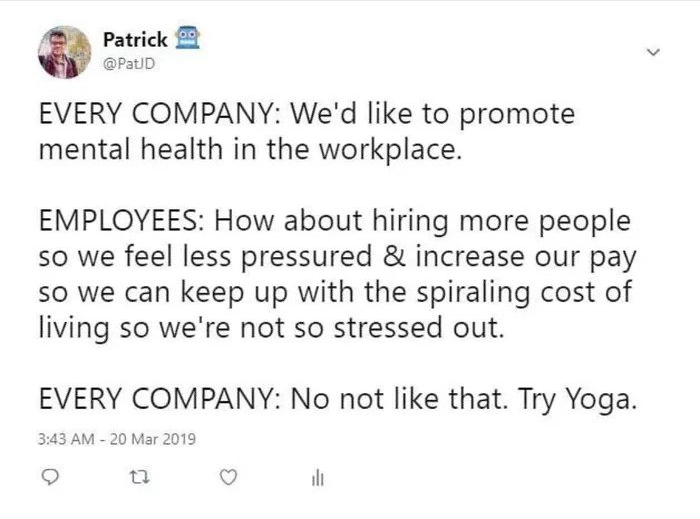
It generated 107,081 views and 362 comments as of the writing of this article.
Below are some comments that stood out. The responses to the post not only echoed his cynicism but provided a clear snapshot of burnout and how it is eroding our health and well-being.
“Or try being open and honest about your mental health issues with your boss to have her basically tell you to suck it up. Good times…”
“Or bring in a ping-pong table that no one has time to play on.”
“My boss installed a quiet zen room. Where if you’re stressed you can remove yourself from the mayhem and fail quietly without any help.”
“yup, empty words to tell your employees to take de-stressing measures when you deny the reason they’re stressed at all is how you treat them”
This is not only occurring online. A few weeks ago one of the folks in the Mindful Leader community shared this with me over email:
“...let me tell you about an experience I had recently. I did a session on workplace mindfulness at a national conference last month. Interestingly, one attendee expressed discomfort with my sharing research and perspective from the corporate/private sector, suggesting I was promoting mindfulness as a way to help people survive within exploitative capitalist systems, rather than helping people wake up to and change the reality of their subjugation”
Many of us have personally experienced the deep benefits of Mindfulness and know the potential that these practices have on helping us individually and collectively thrive and reach our fullest potential. I personally believe we are in a very dangerous place in the history of humanity and that Mindfulness can play a critical role in supporting us through it.
By listening, openly engaging, and evolving, our movement can overcome the backlash and other challenges ahead. We must embrace the criticism and work with it, not try to diminish it, in order to best serve the people we hope to reach and to improve the effectiveness of our efforts.
Have you experienced this type of backlash in your work? What are your thoughts on how best to engage the critics?







Comments